
Cosmetic Dentistry · Harley Street, Marylebone
Composite Bonding vs. Porcelain Veneers
If you are weighing up composite bonding against porcelain veneers, you are asking the right question, because choosing the wrong one for your specific situation can lead to results that either underperform or fail prematurely. Both treatments can transform a smile, but they work differently, last differently, and suit different clinical profiles. At This Is It Dental, Dr. Rena Uberoi makes this decision based on your bite, your teeth, and your long-term goals, not on which option is quicker or more profitable to provide.
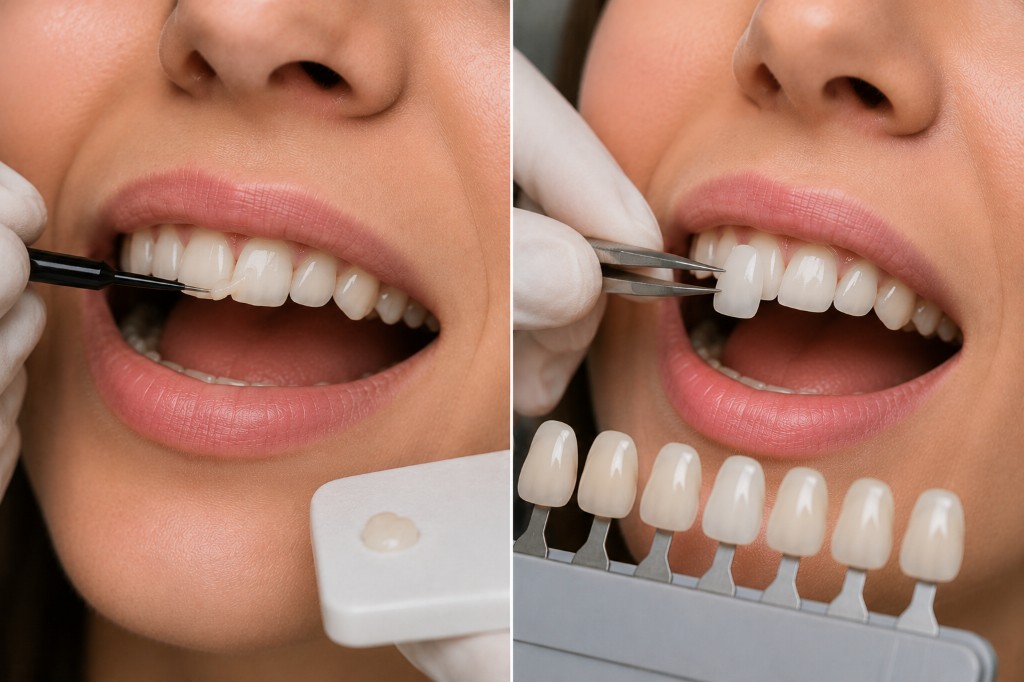
Direct Material Comparison
Composite Bonding: The Conservative, Direct Option
Composite bonding is an entirely additive procedure. The material is applied directly to existing enamel without any structural drilling or local anaesthetic injections. Dr. Uberoi's team shapes, layers, and polishes the resin by hand in a single visit.
Best suited for: Patients looking to repair minor incisal chips, close small gaps (diastemas), or correct minor developmental asymmetries in a single appointment, while leaving 100% of their natural enamel completely untouched.
Porcelain Veneers: The Definitive Ceramic Option
Porcelain veneers are ultra-thin, custom-milled ceramic shells fabricated in partnership with an elite dental laboratory. To ensure the porcelain sits completely flush, a microscopic layer of outer enamel is carefully contoured. This creates a highly stable, durable, and permanent integration.
Best suited for: Patients requiring significant structural changes, full-arch aesthetic corrections, or the masking of severe intrinsic tooth discolouration (such as tetracycline staining) that professional teeth whitening cannot resolve.
The Decision: Which Treatment Fits Your Biology?
Choosing between bonding and veneers requires an honest analysis of your functional bite. During your diagnostic consultation, Dr. Uberoi evaluates several key factors:
-
Bite Forces and Bruxism
If you unconsciously grind or clench your teeth, the immense mechanical pressure can fracture composite bonding over time. High-strength Zirconia or E.max porcelain is clinically superior in these scenarios due to its structural resilience.
-
The Baseline Shade
Composite resin is translucent. If your underlying teeth are severely discoloured, that shade can shadow through a thin composite layer. Porcelain veneers can be engineered with opaque internal cores to block severe discolouration completely.
-
Long-Term Predictability
Porcelain veneers represent a permanent structural commitment but offer a lifelong, maintenance-free surface. Composite bonding is reversible and lower in initial cost, but requires regular professional repolishing to maintain its original gloss.
Transparent fees
| Cosmetic Consultation & Functional Bite Assessment | Confirmed at consultation |
|---|---|
| Composite Edge Bonding (per tooth) | From £450 |
| Premium Master-Crafted Porcelain Veneer (per tooth) | From £1,200 |
Fees confirmed in writing at your consultation. No treatment proceeds without your agreement.
Email Dr Rena Uberoi
Send us an email and we aim to get back to you the same day.
Frequently asked questions
Is it possible to switch from composite bonding to porcelain veneers later?
Yes. Because composite bonding is a purely additive procedure that leaves the underlying enamel completely intact, you can transition to porcelain veneers in the future. We simply remove the composite and prepare the natural tooth surface for the ceramic shells.
Can I have a combination of both treatments?
Absolutely. We frequently design treatment plans combining both disciplines for optimal clinical and economic balance, for instance, porcelain veneers on the central front teeth requiring significant structural reinforcement, with conservative composite edge bonding on adjacent teeth to create seamless facial symmetry.
Does insurance cover the cost of bonding or veneers?
In the vast majority of cases, dental insurance providers classify composite bonding and porcelain veneers as elective cosmetic treatments and do not cover the costs. However, if bonding is performed strictly to repair a tooth damaged by sudden physical trauma or active decay, a portion of the fee may be eligible for coverage under your specific policy.
Book a cosmetic consultation
Book a consultation for an honest assessment and a clear written plan.