Implant Dentistry · Harley Street, Marylebone
Dental Implants
Dental implants are the closest thing modern dentistry has to replacing a natural tooth, a titanium root placed directly into the jawbone, topped with a custom ceramic crown that looks, feels, and functions like the real thing. It is also one of the most varied markets in dentistry, with costs, systems, and clinical standards ranging enormously. What is right for one patient may not be right for another, and suitability can only be determined following a full clinical assessment. Below we walk you through the options and considerations so you can arrive at your consultation better informed.
What a Dental Implant Is
At This Is It Dental in London, Dr. Ramesh Siva treats tooth loss with carefully planned implant dentistry. An implant is a biocompatible, medical-grade titanium screw surgically positioned directly into the jawbone, acting as a replacement for your missing tooth root. Guided by a philosophy of unhurried, exact clinical practice, we utilise 3D computer-guided technology to restore chewing function and natural aesthetics, so your replacement tooth is designed to look, feel and function like a natural one.
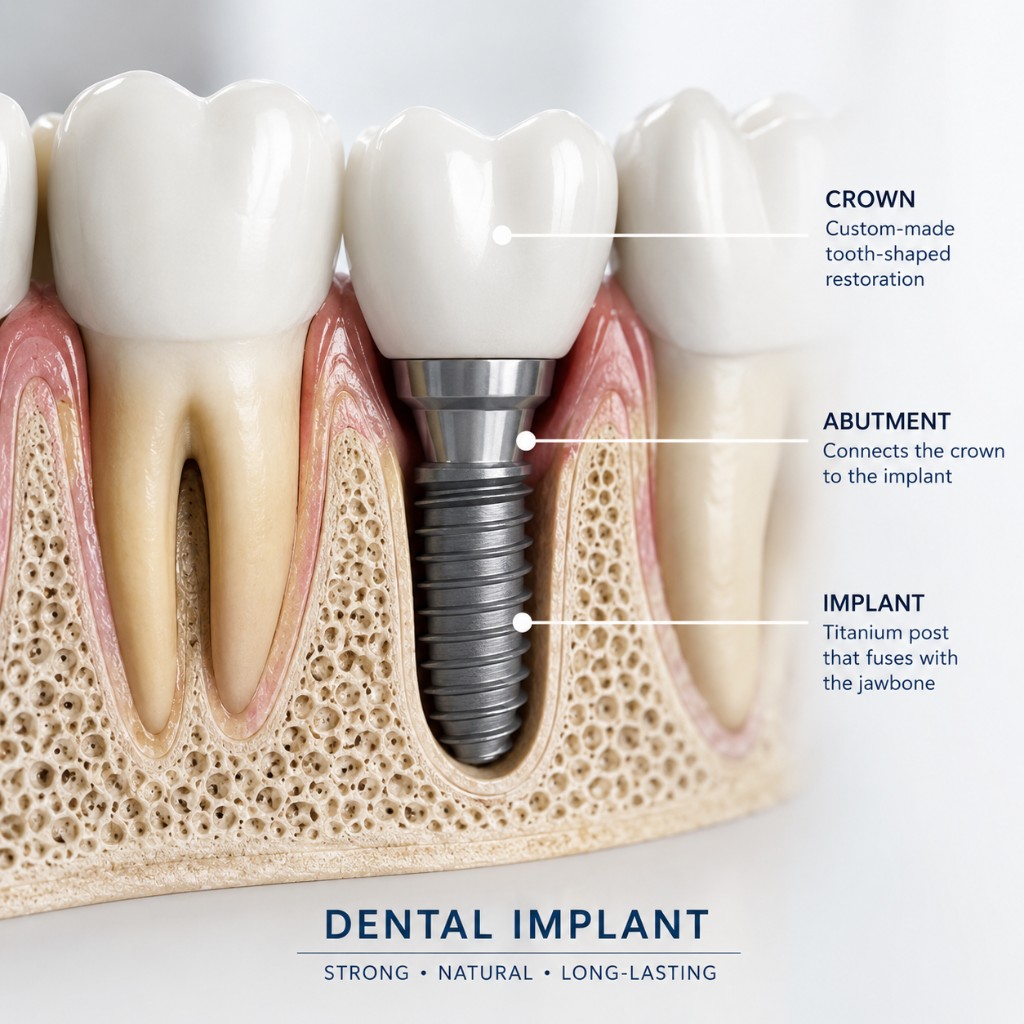
A complete dental implant restoration is engineered from three interlocking components:
-
The Implant Fixture
A threaded, premium titanium or ceramic cylinder surgically embedded in the jawbone. Its micro-textured surface encourages osseointegration, the process where living bone cells fuse to the implant surface.
-
The Abutment
A custom-engineered connector that screws into the internal chamber of the implant fixture, emerging through the gum line to hold the replacement tooth.
-
The Definitive Restoration
The visible, laboratory-crafted portion: a single ceramic crown, a fixed bridge, or a full-arch stabilised prosthesis.
3D Computer-Guided Surgery: Planned for Safety and Accuracy
Historically, implant dentistry relied on freehand placement, a surgeon estimating angle and depth from a 2D X-ray. At This Is It Dental, Dr. Siva's team uses Fully Guided Implant Surgery to reduce clinical guesswork.
We merge a high-resolution 3D CBCT bone scan with a precise digital intraoral scan using specialised software to create a virtual three-dimensional model of your jaw. The planned entry point, depth, angle, and implant size are mapped on-screen, away from the inferior alveolar nerve and maxillary sinuses. A 3D-printed surgical guide is then custom-fabricated. During the procedure, this guide locks firmly onto your teeth and physically directs our instruments with high accuracy, reducing surgical time, enabling micro-incisions, and supporting long-term structural stability.
Your Treatment Journey
-
Comprehensive 3D Diagnostic Mapping
CBCT scan and digital intraoral scan assess bone density, volume, and spatial relationships to vital anatomical structures. If bone volume is insufficient, grafting is planned at this stage.
-
Virtual Simulation & Guide Fabrication
Your surgery is fully planned and rehearsed in digital software. Your custom 3D-printed surgical guide is manufactured by our partner laboratory.
-
Precision Guided Placement
Under effective local anaesthesia. Your surgical guide ensures the implant is placed exactly as planned. A healing cap is positioned and the site closed neatly.
-
Post-Operative PBM Laser Therapy
Applied immediately following placement, painless near-infrared light stimulates cellular healing, accelerates soft-tissue closure, and drastically reduces immediate post-operative swelling.
-
Osseointegration, The Healing Phase
Three to four months of undisturbed biological healing. The jawbone builds dense, living bone tissue around the implant threads, permanently locking it into the skeleton. A discreet temporary tooth is provided throughout so there is never a visible gap.
-
Abutment Connection & Final Digital Scan
Once osseointegration is verified by a digital stability test, the healing cap is replaced by the custom abutment. A final 3D digital scan captures the restoration margins precisely.
-
Definitive Crown Delivery
A master-crafted all-ceramic crown (Zirconia or IPS e.max®) is delivered, verified under magnification, and secured permanently. Bite forces are meticulously balanced using T-Scan digital analysis.
Implant Systems We Use
We partner with Straumann®, Nobel Biocare™, and Ankylos®: global reference standards in implant science. Their titanium-zirconium alloys (Roxolid®) and hydrophilic implant surfaces (SLActive®) are associated with high documented osseointegration success rates in clinical literature, including in patients with reduced bone density.
Transparent fees
| Dental Implant Consultation (with Surgical Adviser) | £250 |
|---|---|
| Dental Implant Fixture (surgical stage, without crown) | From £1,650 |
| Dental Implant Complete (fixture + custom ceramic crown) | From £3,600 |
| 3D CBCT Diagnostic Scan & Surgical Guide Planning | Confirmed at assessment |
Fees confirmed in writing at your consultation. No treatment proceeds without your agreement.
Email Dr Ramesh Siva
Send us an email and we aim to get back to you the same day.
Frequently asked questions
Is dental implant surgery painful?
The entire procedure is performed under effective local anaesthesia. Because our 3D computer-guided approach allows placement with micro-surgical precision, tissue disruption is minimal. You will feel pressure, but not pain. Most patients report that the recovery discomfort is noticeably less than after a standard tooth extraction.
How long do dental implants last?
When placed with precise 3D guidance and maintained with excellent oral hygiene, the titanium root of a dental implant is designed for long-term use. The ceramic crown on top may eventually show structural wear after 10 to 15 years and could require replacement, while the biological foundation within your bone is intended to remain stable for many years with good care.
Can a dental implant fail or develop a cavity?
Because titanium and porcelain are non-biological materials, a dental implant cannot develop decay. However, the gum and bone tissue surrounding the implant remain vulnerable to bacteria. Poor hygiene can cause peri-implantitis, a localised form of gum disease that destroys bone around the implant fixture and can lead to failure. An implant can also fail for mechanical reasons if the bite forces acting on it haven't been properly worked out, just as a natural tooth can be overloaded and fail, an implant crown placed without careful bite analysis can be subjected to excessive force over time. This is why we use T-Scan digital bite analysis to calibrate the pressure on every implant crown we fit. Routine professional hygiene appointments are essential.
Am I too old for dental implants?
There is no upper age limit. The primary criteria are your overall medical health and adequate jawbone density, not your age. Dr. Siva's team has successfully restored chewing function for patients in their 70s, 80s, and beyond. If bone volume has been lost, we can rebuild it with bone grafting before implant placement.
What happens if I do not have enough bone?
Inadequate bone volume is common, particularly when a tooth has been missing for some time. We address this through bone grafting or ridge augmentation depending on the location and degree of deficiency. These procedures are carried out here at This Is It Dental before implant placement.
Book your implant consultation
Book a consultation for an honest assessment and a clear written plan.