Restorative Dentistry · Harley Street, Marylebone
Inlays & Onlays
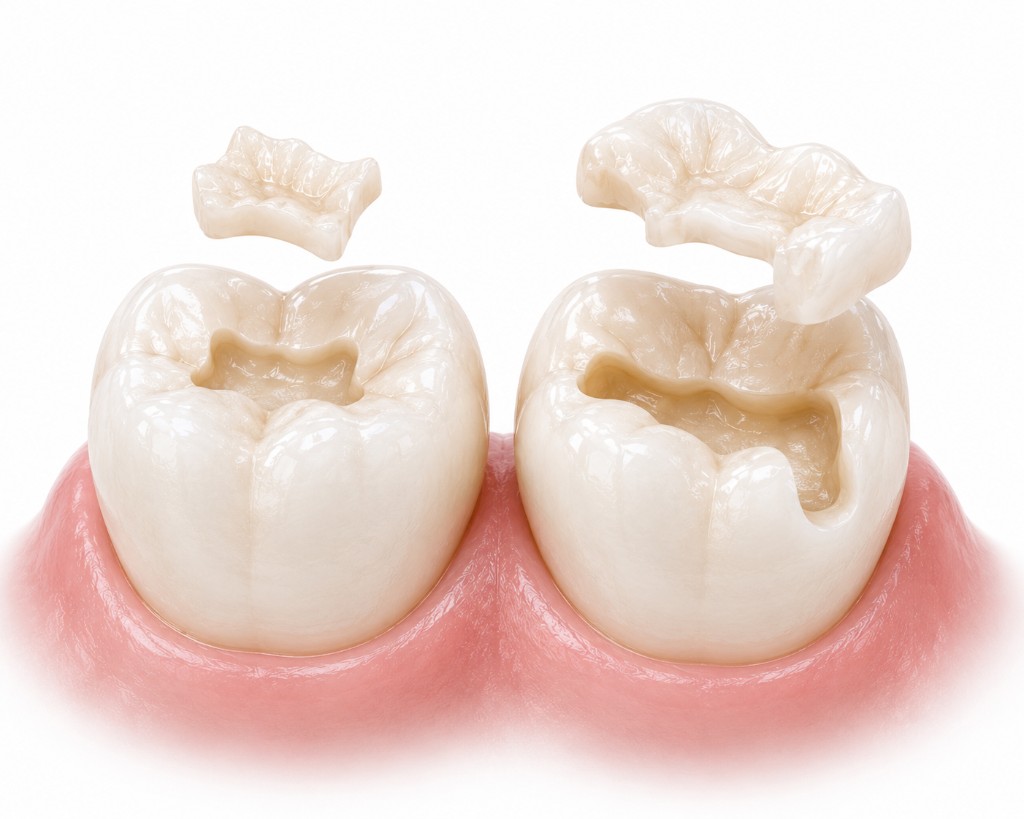
Inlays and onlays are laboratory-made ceramic restorations used when a tooth is too damaged for a standard filling but does not need a full crown. An inlay fits within the cusps of the tooth; an onlay extends over one or more of them. Both preserve significantly more natural tooth structure than a crown, and because they are custom-milled in a laboratory, they are denser, stronger, and more accurate than anything that can be sculpted directly in the mouth.
Inlays vs. Onlays: The Biological Distinction
At This Is It Dental in London, Dr. Rena Uberoi designs custom, laboratory-milled inlays and onlays to restore the structural integrity of compromised teeth. We treat these partial restorations as precision micro-engineering, our focus is on preserving every millimetre of healthy, natural tooth structure, using advanced ceramics that bond chemically to your enamel to rebuild original bite strength.
-
Dental Inlays
Prescribed when active decay or structural fractures are completely contained within the raised borders (cusps) of the tooth's chewing surface. The inlay fits precisely inside the tooth like a bespoke puzzle piece.
-
Dental Onlays
Used when structural damage extends over one or more of the tooth's cusps. Because it covers these chewing points, an onlay structurally reinforces the remaining walls of the tooth, protecting it from splitting apart under the heavy forces of chewing.
Why This Conservative Approach Is Superior
Traditional dental crowns require the permanent removal of up to 75% of a tooth's healthy outer enamel to create a mechanical hold for the crown. We avoid this unnecessary biological loss whenever possible. Because our inlays and onlays are crafted from advanced ceramics that form a high-strength chemical bond directly to the tooth, we only remove the decayed tissue or old, failing filling material. The remaining sound enamel and dentine are left entirely untouched, keeping the biological core of your tooth intact.
The Clinical Process
Appointment 1: Preparation & 3D Digital Scanning
Appointment 2: Flawless Bonding
-
Local Anaesthesia
Highly targeted anaesthesia ensures the tooth and surrounding tissues are completely numb and comfortable before any work begins.
-
Conservative Cleansing
We carefully remove the active decay or old, leaking filling material, sculpting the remaining cavity into a smooth, geometrically precise shape designed to accept the custom restoration.
-
3D Digital Scan
An advanced intraoral camera captures a high-resolution 3D digital blueprint of the prepared tooth and bite alignment, instantly transmitted to our partner laboratory in London.
-
Temporary Protection
A soft, tooth-coloured provisional material is placed to protect the tooth from temperature sensitivity and maintain your bite while the custom restoration is fabricated.
-
Integration & Fit Check
Approximately two weeks later, we trial the custom-milled ceramic inlay or onlay, checking margins under high clinical magnification for a perfectly flush fit against your enamel.
-
Chemical Bonding
Once the fit is approved, the tooth is isolated and the ceramic restoration is permanently bonded using a medical-grade resin adhesive, instantly restoring the full structural strength of the tooth.
Materials We Use
-
IPS e.max® Ceramic
Exceptional flexural strength and a highly translucent finish, blending invisibly with natural tooth enamel.
-
Laboratory Composite / Hybrid Ceramics
Resilient materials that mimic the physical wear patterns and shock-absorbing properties of natural dentine, particularly effective for patients with heavy grinding forces.
Transparent fees
| Inlay (laboratory-crafted ceramic) | From £1,200 |
|---|---|
| Onlay (laboratory-crafted ceramic) | From £1,200 |
Fees confirmed in writing at your consultation. No treatment proceeds without your agreement.
Email Dr Rena Uberoi
Send us an email and we aim to get back to you the same day.
Frequently asked questions
What is the difference between a large filling and an onlay?
A large composite filling is sculpted directly in your mouth from soft material and cured with a light. While effective for small cavities, a very large direct filling can shrink slightly as it sets, creating micro-gaps, and can weaken the tooth walls over time. An onlay is custom-manufactured in a laboratory under controlled conditions, making the material significantly denser, stronger, and more wear-resistant.
Is the procedure painful?
No. Both appointments are performed under effective local anaesthesia, completely blocking pain receptors. You may feel a minor sensation of pressure during the fit check, but you will not experience any sharp pain.
How long do inlays and onlays typically last?
With excellent home care, daily flossing, and routine professional hygiene cleanings, a premium ceramic inlay or onlay typically lasts between 10 and 15 years, and often considerably longer. They are highly stable restorations that do not warp, shrink, or degrade over time.
Can a ceramic inlay or onlay decay?
The ceramic material itself is entirely impervious to decay and chemical erosion. However, the natural tooth structure surrounding the restoration remains vulnerable to plaque accumulation. A meticulous at-home oral hygiene routine is essential to prevent secondary decay from forming along the margins. Ceramic is also far less prone to wear than composite, which makes it a particularly suitable choice for patients with bruxism or heavy biting forces.
Book an inlay consultation
Book a consultation for an honest assessment and a clear written plan.