Diagnostic Technology · Harley Street, Marylebone
Tekscan (T-Scan) Digital Bite Analysis
T-Scan is a digital bite analysis system that measures the precise timing and force of every tooth contact when you close your jaw, something traditional articulating paper simply cannot do. An unbalanced bite, where one tooth hits a fraction too early, is one of the most common and least-diagnosed causes of cracked teeth, failing restorations, and chronic jaw pain. At This Is It Dental, T-Scan analysis is used routinely before and after complex restorative work to ensure every case is balanced correctly.
Why Bite Timing Matters
At This Is It Dental in London, Dr. Rena Uberoi eliminates this guesswork using Tekscan (T-Scan™) Digital Bite Analysis. This is not commonly used in general practice, very few dentists own the equipment or are trained to use it properly, and Dr. Uberoi has undertaken dedicated advanced training in both T-Scan and EMG analysis. Traditional ink articulating paper, still the standard tool in most practices, can only show where teeth touch, it cannot tell you the timing or force behind each contact, which is exactly the information that matters most. This state-of-the-art technology maps the precise dynamic forces of your bite in real time, visualising the timing, balance, and force distribution of your occlusion, and ensuring your natural teeth, implants, and restorations are structurally protected from destructive mechanical stress.
When your jaw closes, your teeth should ideally make contact simultaneously, distributing chewing forces evenly. If a single tooth contacts even a fraction of a millisecond before the others, a clinical condition known as a premature contact, it absorbs the full initial force of the jaw muscles. This continuous micro-trauma triggers a cascade of consequences:
-
Restorative Failure
Porcelain veneers, crowns, and composite bonding repeatedly chip, fracture, or debond when subjected to concentrated, unbalanced bite forces.
-
Structural Tooth Damage
Excessive force causes teeth to loosen, split, or develop abfractions (enamel notches at the gum line).
-
Periodontal Degradation
Overloaded teeth experience accelerated localised bone loss as the supporting periodontal ligament is chronically inflamed.
-
Neuromuscular Strain (TMJ)
To avoid a painful premature contact, the jaw muscles unconsciously alter the chewing path, forcing the joint out of natural alignment and triggering chronic spasms, clicking, and tension headaches.
How T-Scan Technology Works
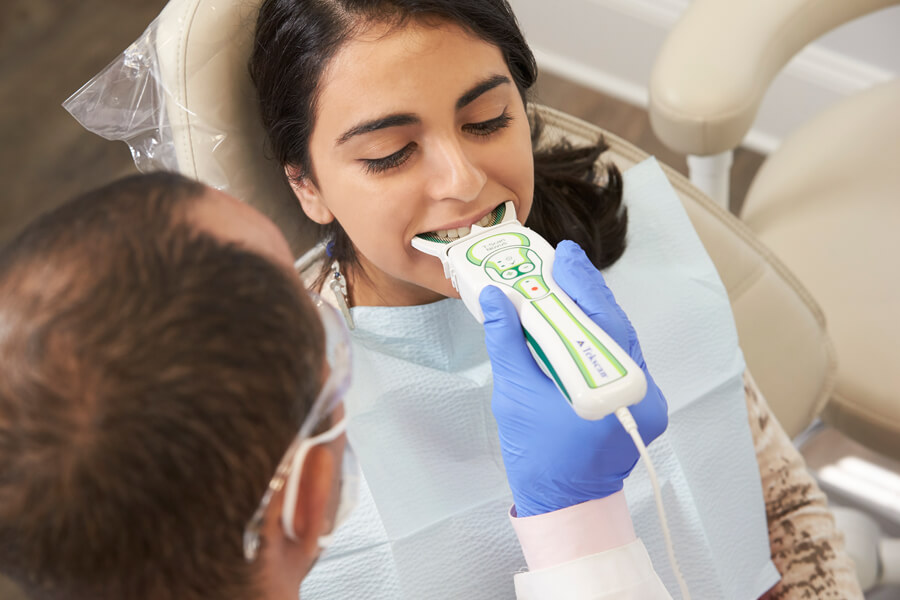
The system utilises an ultra-thin, hand-held electronic sensor containing a dense grid of microscopic pressure-sensitive resistors. As you bite down and move your jaw, the sensor records force variations at every single contact point simultaneously. This data is instantly displayed on our screens as an interactive 3D force map, showing exactly which teeth are hitting first, the percentage force distribution between the left and right sides, and how your teeth disengage through your range of movement.
The Clinical Process
-
Visual and Physical Palpation
We begin by examining jaw joint movement and facial muscle tension, checking for signs of chronic strain or clicking.
-
Digital Scan Capture
The ultra-thin T-Scan sensor is placed in your mouth. You bite down normally, squeeze your teeth together, and move your jaw through its natural range. The entire scan is completed in seconds.
-
Real-Time Dynamic Review
We review your 3D bite analysis on-screen together. The software highlights exactly which teeth are hitting first, the force distribution left to right, and the trajectory of your bite throughout movement.
-
Precision Micro-Adjustment (Equilibration)
If an imbalance is detected, Dr. Uberoi uses the T-Scan data as a precise guide to smooth away microscopic high points on the tooth or restoration until the software shows a perfectly balanced, symmetrical force distribution across the arch.
Key Clinical Applications
-
Cosmetic & Restorative Dentistry
Before permanently bonding smile makeovers, porcelain veneers, or crowns, T-Scan confirms new restorations do not interfere with your natural chewing trajectory.
-
Dental Implant Protection
Natural teeth flex slightly under load via their periodontal ligament. Dental implants have zero give. T-Scan calibrates implant crown pressure precisely so it does not absorb destructive excess force.
-
TMJ & Chronic Pain Therapy
By locating and correcting the specific premature contacts forcing the jaw joint out of alignment, we permanently unload the strained muscles, resolving chronic headaches at their source.
Transparent fees
| Mini T-Scan Digital Bite Analysis | £290 |
|---|---|
| Full T-Scan Digital Bite Analysis | £490 |
| Precision Occlusal Equilibration (T-Scan guided adjustments) | From £290 |
Fees confirmed in writing at your consultation. No treatment proceeds without your agreement.
Email Dr Rena Uberoi
Send us an email and we aim to get back to you the same day.
Frequently asked questions
Does a T-Scan analysis hurt?
Not at all. The sensor is ultra-thin and completely flexible. The procedure involves nothing more than biting down naturally on a soft wafer. No injections, no drilling, no discomfort of any kind.
Why hasn't my previous dentist used this technology?
Tekscan is specialist equipment requiring significant clinical investment and dedicated postgraduate training in occlusal dynamics. Many high-volume practices continue to rely on traditional articulating paper, which provides a useful but fundamentally incomplete picture, it shows contact location but cannot measure the critical dimension of force over time.
How many sessions are needed to balance a bite?
In many cases, the scan, analysis, and micro-adjustments can all be completed in a single unhurried appointment. For long-standing TMJ dysfunction or complex bite corrections, Dr. Uberoi may perform adjustments across two or three sessions to allow the jaw muscles and joints to settle progressively into their new, balanced position.
Will balancing my bite involve drilling away a lot of tooth structure?
Absolutely not. T-Scan provides micron-level accuracy, showing exactly where a high point sits. We only need to smooth away a microscopic fraction of the outer enamel layer, often less than the thickness of a strand of hair. The step is entirely non-invasive, painless, and preserves the absolute maximum amount of healthy tooth structure.
Book a bite analysis
Book a consultation for an honest assessment and a clear written plan.