
Restorative Dentistry · Harley Street, Marylebone
Dental Bridges
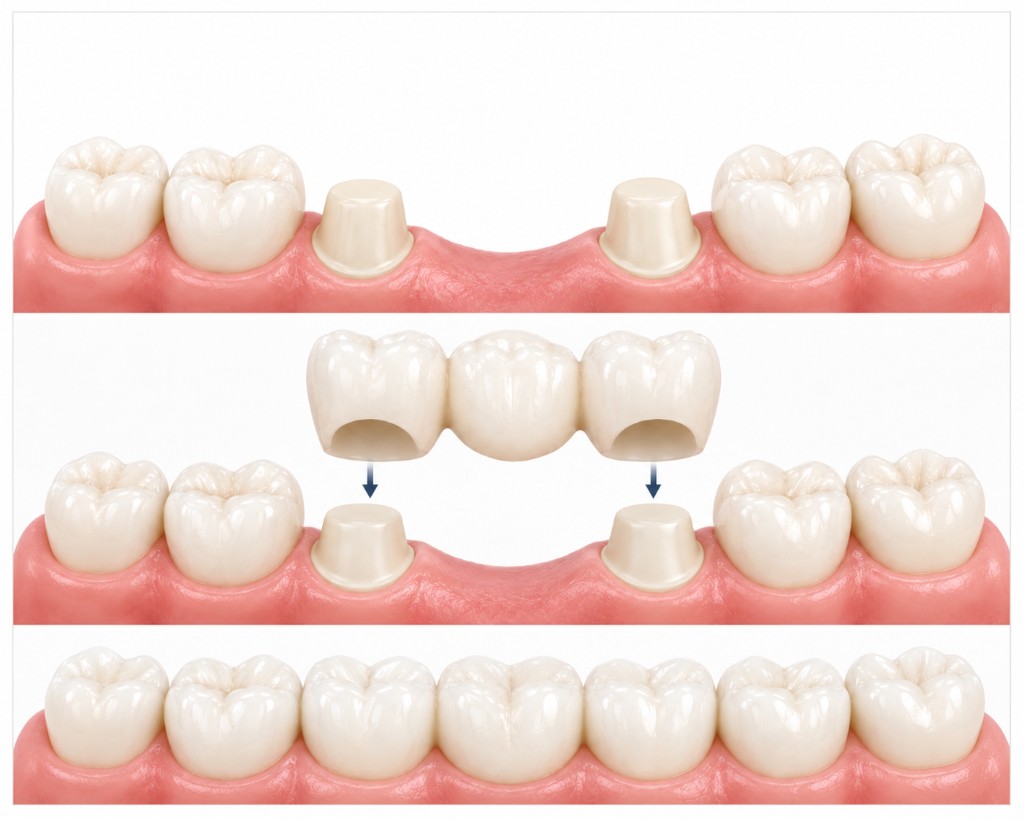
A dental bridge is a fixed restoration used to replace one or more missing teeth by anchoring an artificial tooth, or teeth, to the natural teeth on either side of the gap. It is a well-established solution that restores both function and appearance without surgery. At This Is It Dental, every bridge is designed with precise bite mechanics in mind, because a bridge that is even fractionally misaligned will place damaging forces on the anchor teeth over time.
Our Engineering Approach
At This Is It Dental in London, Dr. Rena Uberoi engineers custom dental bridges to permanently replace missing teeth and restore full chewing function. A successful dental bridge must be balanced to the exact micro-mechanics of your bite. If a bridge is even a fraction of a millimetre too high, the continuous forces of chewing will apply excessive leverage to the anchor teeth, leading to bone loss, root fractures, and eventual failure of the entire unit.
We perform a thorough diagnostic evaluation of bite mechanics before shaping any teeth, and we have replaced messy putty impressions entirely with high-resolution 3D digital intraoral scanning. This digital blueprint allows our partner laboratory in London to mill a prosthesis that distributes chewing forces evenly across the jaws, protecting the natural anchor teeth long-term.
Understanding Bridge Anatomy
-
The Abutments
The healthy, natural anchor teeth on either side of the empty space, precisely contoured to serve as the structural pillars supporting the entire bridge.
-
The Pontic
The custom-crafted replacement tooth suspended in the gap, resting comfortably against the gum line to completely restore the missing tooth structure.
The Clinical Process
Appointment 1: Precision Shaping & 3D Scanning
Appointment 2: Flawless Bonding
-
Diagnostics and Anaesthesia
Root health and bone density of the anchor teeth are evaluated with digital radiographs. Local anaesthetic is administered to ensure complete comfort throughout.
-
Abutment Preparation
The outer enamel layers of both anchor teeth are carefully contoured to create a secure, mathematically balanced foundation for the ceramic bridge crowns.
-
3D Digital Capture
An intraoral scanner captures a highly accurate digital model of the prepared teeth and bite, instantly transmitted to our master ceramist.
-
Provisional Bridge
A custom temporary bridge is fabricated and bonded, protecting the anchor teeth and maintaining bite alignment while the definitive prosthesis is crafted.
-
Structural Fit Trial
The custom ceramic prosthesis is trialled and checked under magnification for margin accuracy, contact points, and aesthetic harmony.
-
Definitive Cementation
Once aesthetics, bite alignment, and margin integrity are completely verified, the bridge is permanently bonded using high-strength medical resin adhesive.
Transparent fees
| Premium All-Ceramic Bridge (per unit / tooth involved) | From £1,200 per unit |
|---|
Fees confirmed in writing at your consultation. No treatment proceeds without your agreement.
Email Dr Ramesh Siva
Send us an email and we aim to get back to you the same day.
Frequently asked questions
What is the difference between a bridge and an implant?
A dental bridge relies on the adjacent natural teeth for structural support, those anchor teeth must be permanently contoured to hold the bridge. A dental implant is an independent titanium root placed directly into the jawbone, leaving adjacent teeth completely untouched and preserving the underlying bone. If the teeth next to the gap are already heavily filled or damaged, a bridge is often the more practical option as it simultaneously restores and protects those teeth.
Is the preparation painful?
No. The entire procedure is performed under effective local anaesthesia. You will feel pressure and vibration during the reshaping process, but not sharp pain.
How do I clean underneath a dental bridge?
Because a bridge is permanently joined together, standard floss cannot pass vertically between the teeth. We provide specialised interdental tools, floss threaders or a water flosser, and demonstrate exactly how to safely clean these areas to keep the underlying gums and anchor teeth healthy long-term.
How long does a ceramic bridge last?
With meticulous daily oral hygiene, dedicated interdental cleaning, and regular dental check-ups, a custom ceramic bridge typically lasts between 10 and 15 years, often considerably longer.
Book a bridge consultation
Book a consultation for an honest assessment and a clear written plan.