Advanced Surgical Care · Harley Street, Marylebone
Bone Grafting
Bone grafting is a surgical procedure used to rebuild the jawbone where volume has been lost, most commonly after tooth loss, gum disease, or a long gap before implant placement. Without sufficient bone, a dental implant cannot be placed safely or predictably. At This Is It Dental, Dr. Ramesh Siva uses advanced 3D imaging and microsurgical techniques to plan and carry out bone regeneration procedures, creating the biological foundation needed for long-term implant success.
Why Bone Volume Matters
If dental implants are placed into an atrophied jawbone with inadequate height or width, the implant will lack the structural support required to withstand the forces of chewing and will eventually fail. Bone grafting procedures restore the lost skeletal architecture, creating the biological environment necessary for permanent, stable implant integration.
Regenerative Techniques
1. Guided Bone Regeneration (GBR) / Ridge Augmentation
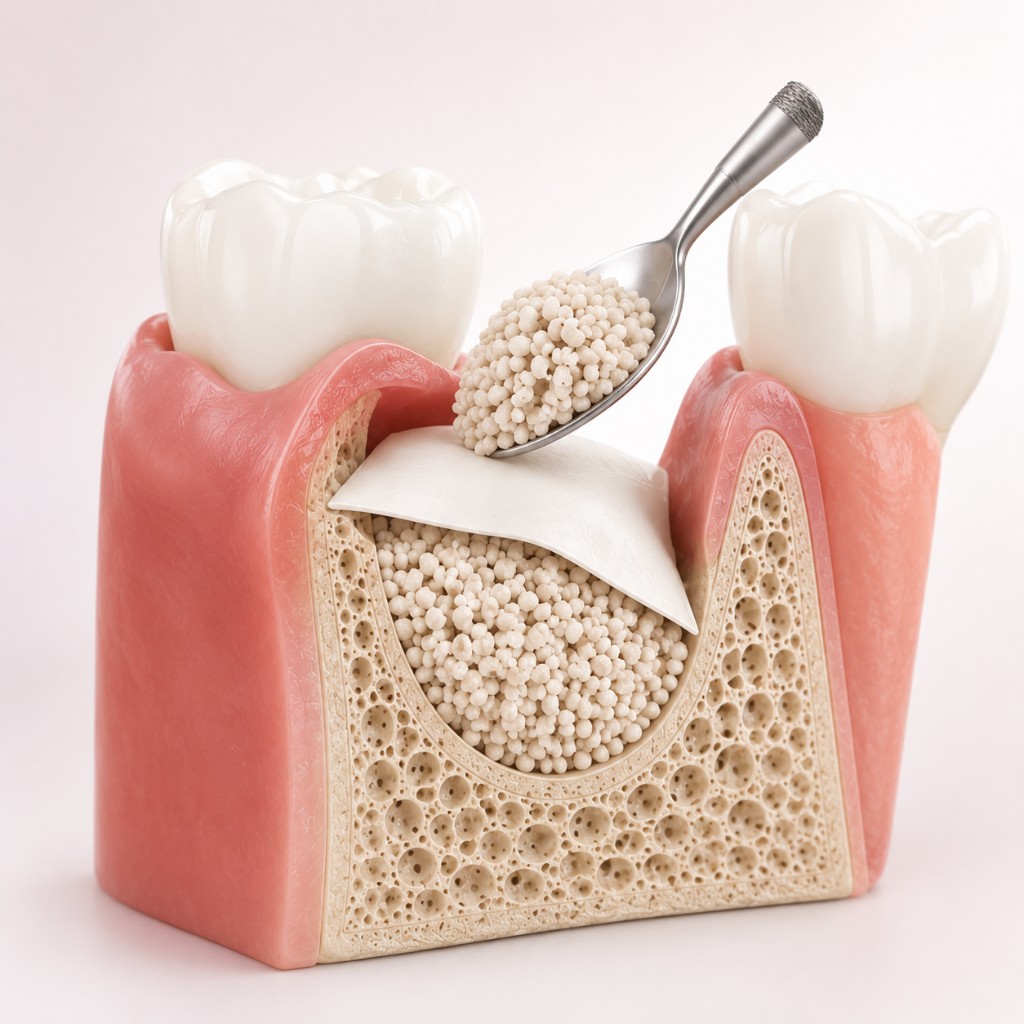
When a tooth has been missing for a significant period, the alveolar ridge (the bone width that once anchored the tooth) begins to narrow and flatten. During ridge augmentation, we carefully place high-grade bone grafting material onto the deficient area, then overlay it with a specialised biocompatible collagen membrane. This membrane blocks fast-growing gum tissue from entering the site, allowing the slower-growing bone cells to populate the graft and regenerate a robust, wide foundation.
2. Socket Preservation
The optimal moment to manage bone loss is at the exact moment a tooth is removed. When an unsavable tooth is extracted, a hollow socket remains in the jawbone. If left empty, the surrounding bone walls will collapse inward by up to 40% in height and width within the first six months. By packing the empty socket with bone graft material immediately at the time of extraction, we maintain the natural architecture of your jawbone and prepare the site perfectly for a future implant.
The Safety of 3D CBCT Radiography
Surgical bone regeneration requires sub-millimetre precision to map vital anatomical landmarks, including the path of the inferior alveolar nerve in the lower jaw. Dr. Siva's team uses high-resolution 3D CBCT scanning before any surgical planning, generating a complete three-dimensional digital model of your jaw. This ensures the entire approach is meticulously planned before you ever sit in the chair.
The Surgical Process
-
Complete Local Anaesthesia
Highly targeted anaesthesia completely desensitises the surgical site and surrounding nerve pathways. We dedicate ample time for full effect, you will feel absolutely zero sharp pain during the surgery.
-
Microsurgical Access
A precise incision in the gum tissue exposes the area of bone deficiency, using magnification to keep the surgical window as small and neat as possible.
-
Graft Material Placement
The sterile bone graft material is carefully packed into the area. It acts as a biological scaffold, not permanent foreign bone, but a structure that triggers your body's own healing response to gradually replace it with living bone cells.
-
Collagen Membrane Stabilisation
A custom-cut, dissolvable collagen membrane isolates the graft site and is secured with biocompatible sutures to promote stable, primary tissue healing.
-
Immediate Post-Operative PBM Laser Therapy
Applied immediately following the procedure to stimulate cellular mitochondria, accelerate soft-tissue closure, manage post-operative discomfort, and significantly reduce immediate swelling.
Premium Biocompatible Materials
-
Mineralised Allograft Matrix
Sterilised, highly purified human bone tissue from regulated bone banks, possessing the ideal mineral structure to promote rapid human bone growth.
-
Anorganic Bovine Bone Matrix (Bio-Oss®)
A globally renowned, highly biocompatible material whose microscopic porous structure is chemically identical to human bone, providing an exceptionally stable, long-lasting scaffold that resists resorption.
-
Resorbable Collagen Membranes (Bio-Gide®)
Pure porcine-derived collagen sheets providing optimal barrier function for several weeks before naturally dissolving into the body, no second surgery required for removal.
Transparent fees
| Surgical Consultation & Detailed 3D CBCT Diagnostic Scan | Confirmed at assessment |
|---|---|
| Localised Socket Preservation (at time of extraction) | From, confirmed at assessment |
| Guided Bone Regeneration (Ridge Augmentation) | From, confirmed at assessment |
Fees confirmed in writing at your consultation. No treatment proceeds without your agreement.
Email Dr Ramesh Siva
Send us an email and we aim to get back to you the same day.
Frequently asked questions
Is bone grafting painful?
No. The entire procedure is performed under effective local anaesthesia, which entirely blocks pain receptors. You will feel a mild sensation of pressure and the washing of irrigating liquids, which is normal, but no sharp pain. We work completely at your pace throughout.
What is the recovery process like?
Most patients experience a healing period of three to seven days. Mild swelling, bruising, and a dull ache around the cheek or jaw are completely normal biological responses as the healing cascade initiates. By combining advanced microsurgical techniques with immediate post-operative PBM laser therapy, Dr. Siva's team actively minimises the swelling and discomfort typically associated with oral surgery.
How long does it take for the graft to become real, living bone?
The biological process of bone remodelling, where your body slowly dissolves the scaffold and replaces it with dense, living human bone, typically takes four to six months to mature completely. Once this period is complete, we verify the density using a short digital scan before safely placing your permanent dental implant.
Book a grafting consultation
Book a consultation for an honest assessment and a clear written plan.